THE HISTORY OF CEDAR POINT MILL
Executive Summary
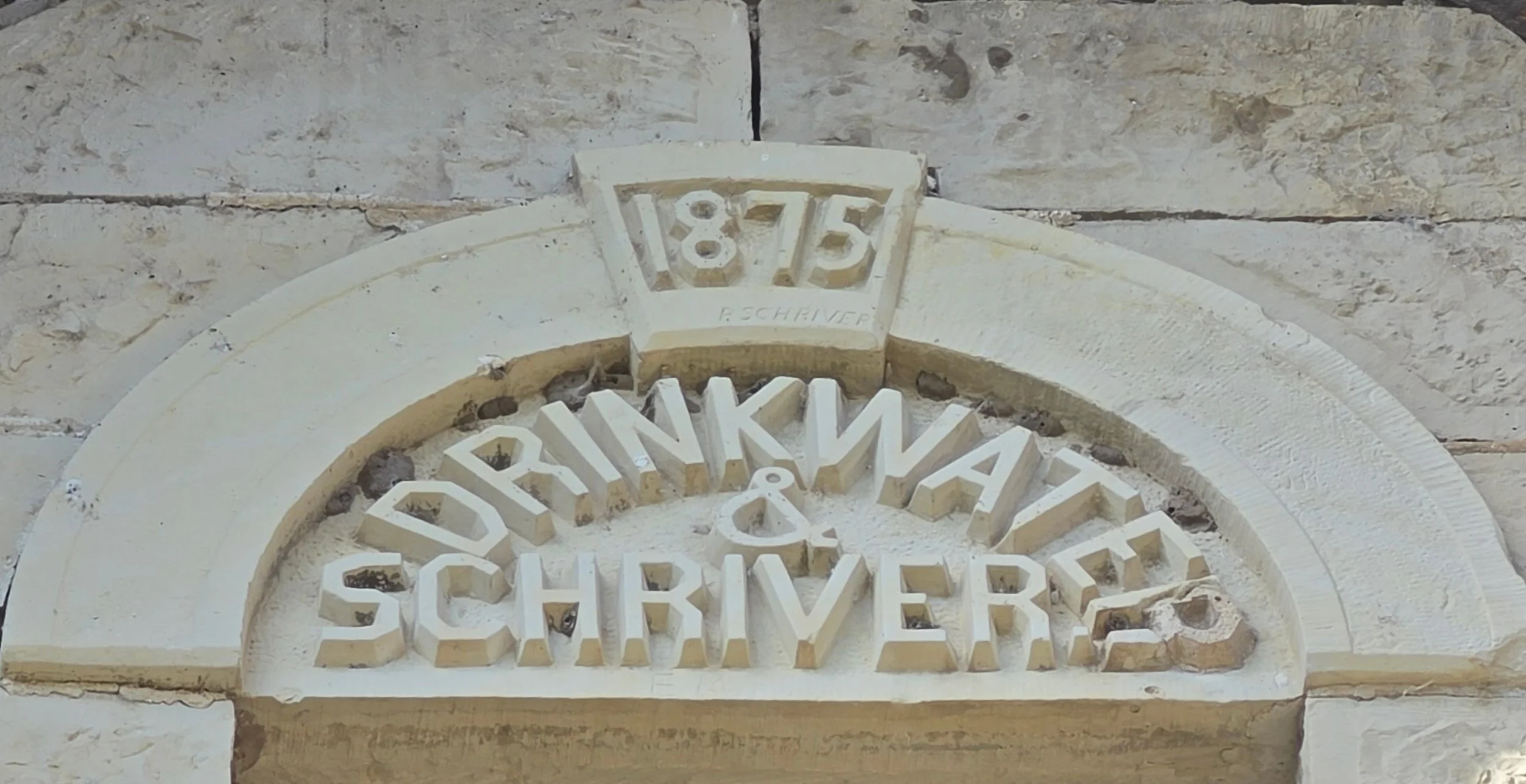
For more than a century and a half, the Cedar Point Mill has stood where the Cottonwood River meets the Flint Hills. It began in 1867 as a wooden sawmill built by Captain Orlo H. Drinkwater, a Free-State pioneer who founded Cedar Point, and his partners; by 1868 it was grinding flour, and in 1875 Drinkwater and Peter Paul Schriver replaced the flood-prone wooden structure with the five-level limestone mill that stands today. Powered by the river through a stone-lined channel and turbine, the mill ground wheat into flour for 66 years, reaching 100 barrels a day at its peak, then spent three more decades grinding livestock feed for Flint Hills cattlemen before retiring in 1988. Listed in the National Register of Historic Places in 2006 and owned since 2015 by Drinkwater and Schriver Mill, Inc., a 501(c)(3) non-profit, the mill is now the focus of a community effort to stabilize and preserve one of Kansas’s finest surviving examples of nineteenth-century industrial architecture. The full story, with all its floods, oxen, and bicycles, follows below.
The Mill at a Glance
1857: Drinkwater settles at Cedar Point, builds the cabin known as “Fort Drinkwater,” and serves in the last session of the Free-State Legislature.
1867: Drinkwater and J.L. Crawford build a log dam across the Cottonwood River and a wooden sawmill.
1868: The mill is converted to grind flour; Drinkwater buys out Crawford.
1869–1870: Schriver joins partnership, mill becomes Drinkwater and Schriver.
1871: A flood destroys the wooden mill; construction of the limestone mill begins.
1875: The five-level limestone mill is completed, has capacity of 75 barrels per day.
1884: A stone dam replaces the log dam.
1903: A front office and granary addition is built; capacity reaches 100 barrels per day.
1923: Arnold Brunner buys the mill and becomes Cedar Point’s last flour miller.
1941: Ray F. Crofoot buys the mill and begins grinding livestock feed
1940’s: Mill is fully electrified
Late 1970s: A.L. “Chub” Pinkston buys the mill and continues feed production.
1988: Dr. Bruce McMullen buys the mill, milling activities have stopped by now.
1999–2000: K-State students list mill with Historic American Buildings Survey.
2006: The mill and dam are listed in the National Register of Historic Places.
2015: Drinkwater and Schriver Mill, Inc. non-profit is formed to preserve mill.
2015: Deteriorated 1903 front addition removed to expose limestone facade.
2026: Kyle Latinis and Johanna Beilfuss become co-directors of the non-profit.
FULL HISTORY
Cedar Point Mill (also known as the Drinkwater and Schriver Mill)
The Cedar Point Mill has a fascinating history of architecture, industry, and people. A thorough telling would require an epic, multi-season Netflix series. Truth is certainly stranger than fiction, including the local anecdote that Captain Orlo H. Drinkwater, the Mill’s founder, once traded a piece of land in Topeka for a cow. That land is where the Kansas State Capitol now stands. Captain Drinkwater reached Cottonwood Valley in Chase County, Kansas, in 1857 by a circuitous route. It began in Pennsylvania in 1855 and passed through the “Village of Kansas” (today’s Kansas City, Missouri), where he stayed at the American Hotel. From there he and his brother Delos drove their ‘latest model’ ox-cart across the state line into Kansas Territory to join their father, who had already taken a claim on Shunganunga Creek near Topeka. Father and sons rented 80 acres of ‘broke land’ west of Topeka from Abram Burnett, a Potawatomi chief, and Drinkwater hauled freight between Topeka and Kansas City behind two oxen whose names history has faithfully recorded: ‘Mooley’ and ‘Dave’. They hauled for Allen and Gordon, ‘two very prominent merchants in Topeka,’ and were paid one dollar per hundred pounds. That fall, Mooley and Dave earned a small place in Kansas history of their own: Drinkwater’s ox-cart carried the first printing press brought to Topeka, on which E.C.K. Garver printed the Kansas Freeman. Time passed and a lot more stuff happened. Drinkwater was actively involved in Kansas politics and action groups: he was an ‘ardent Free-State’ advocate who followed John Brown and Jim Lane, took part in the Border War, and served in the Free-State Legislature at its last session in 1857. Drinkwater was becoming more Kansas than Kansas itself, and could justifiably have claimed to be carved out of Flint Hills chert and limestone in the Tallgrass Prairie, rather than hailing from Pennsylvania. Finally… Drinkwater arrived in Cedar Point in 1857 (Cottonwood Valley, Chase County, Kansas; yes, we are returning to the Mill history), where he established a farm and built a log cabin known locally as “Fort Drinkwater,” which became a gathering place and safe haven for the community. He also secured a post office, which he named Cedar Point, and, unsurprisingly, became its first postmaster. Over the next decade even more stuff happened, and much bigger stuff, including the American Civil War, in which Drinkwater served as a commissioned Captain, and his continued support for Kansas Free-State values and causes. He remained active in politics until his death in 1912, at the age of 77, after being struck by a bicycle while walking in Cedar Point. He is buried in Drinkwater Cemetery near Main Street, laid to rest by the... yes... Grimwood Brothers, evidently the undertakers…. We couldn’t make this stuff up. In 1867 O.H. Drinkwater and J.L. Crawford built a log dam across the Cottonwood River and a wooden mill at Cedar Point. It began life as a sawmill, cutting lumber for a town that was still being built; in 1868 Drinkwater bought out Crawford and converted it to grind flour, and the Cedar Point Mill was born. In 1869 he took on two new partners, L.C. Smith and Peter Paul (P.P.) Schriver. Schriver, too, had been drawn to Cedar Point from Pennsylvania (although it is doubtful that Mooley and Dave were involved in his journey). Drinkwater and Schriver bought out Smith in 1870, and the business operated under the Drinkwater and Schriver name until 1891, when Drinkwater sold his interest. Hence, Cedar Point Mill is also known as the Drinkwater and Schriver Mill. The original wooden mill and dam were washed away by floods in 1871, probably more than once, or at least prominent parts of them were. The Cottonwood River periodically floods along this particular stretch (hence the “flood zone” warning signs at the edge of town). It wouldn’t be surprising if large chunks of the mill and dam made it all the way to Chase County’s most prominent city, Cottonwood Falls, adding yet another dimension to its rich archaeological and architectural history. The mill and dam were built quite literally “into” the Cottonwood River and “on top of” the Flint Hills bedrock to harness the river’s power, which drove the area’s early mechanized agricultural industry. This was an early example of industrial renewable energy, alongside wind power (the Kansas plains having no shortage of wind, seemingly ever). Wind farms now dot the surrounding landscape, and Kansas is a leading producer of wind energy. But, to be clear, the Cedar Point Mill (aka the Drinkwater and Schriver Mill) was a water-powered flour and feed mill, not a windmill, an occasional point of confusion. Between 1871 and 1875, Drinkwater and Schriver built a new mill and dam out of local Flint Hills limestone, a far more robust and durable material. Finished in 1875, the five-level architectural wonder (often described as three stories plus a basement; see the Architecture and Engineering notes for why we count five) housed a mesmerizing mechanized network of shafts, gears, belts, chutes, grinders, levers, pulleys, hoppers, and unexplainable parts that would fascinate a master clockmaker, all of it capable of turning out 75 barrels of flour a day. The lowest level contained a stone-lined canal with stone arches in the east and west walls that let water flow through to power the machinery. P.P. Schriver himself dressed some of the stonework and made the mill’s date-stone. Large limestone-block retaining walls were built along the east–west riverbank on the mill property. They are prominent in early photographs and descriptions, clearly abutting the exterior east and west mill walls at exactly the locations of the interior retaining wall, but they are now gone: eroded, flood-damaged, removed, buried, or somewhere downstream with the remains of the earlier wooden mill and dam. Images and descriptions of these walls are noticeably absent from modern records, although older residents remember them well. The western retaining wall is clearly visible in one of the early iconic photos of two women fishing from a boat near the dam. The stone dam was built in 1883–84 to improve water-power efficiency and, most likely, to replace the earlier log dam, which may also have partially or wholly washed away (adding yet more debris to the downstream artifacts piling up). In case readers are wondering: yes, there are beaver in the area, and we have no idea how many beaver and beaver lodges have been forcibly relocated by floods, either. In 1903 a new addition, a wood-and-tin office and grain storage area, was attached to the southern (front) end of the mill, and with it capacity climbed to an impressive 100 barrels of flour per day. This was one of the mill’s peak production periods: thousands of sacks of flour made their way directly to Ireland, and the Cedar Point Mill was, in effect, feeding international export markets. The addition included a “drive-through” for loading and unloading, possibly one of the first drive-throughs in the area. (We’re still investigating this point; archaeological evidence from current landscaping work suggests several paved areas would have accommodated a drive-through for wagons, horse carts, early motor vehicles, and possibly even oxen, perhaps descendants of Mooley and Dave.) Then, in 1907, tragedy struck. Peter Paul Schriver, 61, was hit and killed by a Santa Fe train while riding his bicycle on the west side of Cedar Point, where the tracks cross the main road. His son Paul took over operations and ran the mill with his mother and other family members until 1917, after which it sat largely idle, operating only periodically, through 1923. During Paul’s tenure the front granary, office additions, and drive-through were modified and expanded. After Paul’s death, his widow sold the mill to Mr. Arnold Brunner in 1923, and Cedar Point gained what would turn out to be its last flour miller. Brunner owned and ran the mill for eighteen years, through the Dust Bowl and Great Depression of the 1930s, keeping it operating and producing flour and keeping it an important part of the local economy in extremely difficult times. Those years were hard on the river as well as the farmers: silt and debris choked the Cottonwood, and at times it ran dry. With too little water to turn the turbine reliably, Brunner supplemented water power with other sources, modified and upgraded the machinery, and scaled production down to leaner, more adaptable operations, roughly from 250 bushels of wheat per twelve-hour day to about 100. What Brunner clearly did have was electricity of his own. In PrairyErth, William Least Heat-Moon indicates that the mill was set up to produce (not receive) direct-current electricity, writing that “Mr Brunner passed the hours from dusk until ten P.M. by popping back in the chair and dozing, then he’d get up and go to the control board and ‘unplug the town’ ... One night he even threw the school board into the dark when a meeting ran long and he refused to flip the switch on again, said it was ‘high time to be in bed’.” So during Brunner’s tenure the mill may well have been doing double duty, grinding flour by day and lighting Cedar Point by night, quite an accomplishment for the area in those times. Mr. Brunner sold the mill in 1941 to Mr. Ray F. Crofoot, a prominent Flint Hills cattleman who took the opportunity to streamline his livestock and feedlot operations. Crofoot converted the mill’s main function to producing coarse livestock feed rather than finely ground flour, reconfigured the machinery, and in the late 1940s fully electrified production, rendering much of the older water-driven flour-milling machinery and architecture obsolete. He bought grain locally, processed it into feed, and fed most of it to his own cattle. Sixty-six years of water-powered flour milling had come to an end, yet the mill continued to evolve and operate successfully for three more decades. Crofoot eventually closed his regional operations and, in the late 1970s, sold the mill to Alfred Lee “Chub” Pinkston (A.L. Pinkston), another prominent Chase County cattleman whose family roots reach back to the early days of Flint Hills settlement, farming, and ranching, and to Cedar Point’s founding. He kept the mill in use for feed production. In 1988, as the agricultural industry in the Midwest continued to evolve, Pinkston sold the property to Dr. Bruce McMullen, and the Cedar Point Mill was retired. It remained, however, an important legacy: of cultural identity, past industry and economic life, adaptation, and unique architecture and engineering, set in an equally unique landscape and ecology. Preservation interest began to take shape as the century turned. In 1999, local supporter Barry Linnens and fellow Kansan Dan Clothier (who has a lifelong passion for the mill and for historic preservation: see the iconic Freight House dining district in Kansas City) brought in Kansas State University’s interior architecture program. Professor James Dubois and a studio of nineteen students spent the 1999–2000 academic year studying the mill, and in the spring of 2000 they presented a set of proposals for its redevelopment. Just as valuable, the students produced detailed measured drawings of the building, which were filed with the National Park Service’s Historic American Buildings Survey, giving the mill a permanent documentary record for the first time. The Cedar Point Mill (alternate name: Drinkwater and Schriver Mill) was officially listed in the National Register of Historic Places on December 20, 2006, on behalf of the Chase County Historical Society. The nomination was researched and written by Patty J. Donelson and Pat H. Sauble. Restoration in earnest began in 2015. That year Clothier formed Drinkwater and Schriver Mill, Inc. as a Kansas 501(c)(3) non-profit to purchase the mill from Dr. McMullen and to raise funds for its preservation; he and his wife, Kris, provided the seed money, and the sale closed in April 2015. The non-profit’s first order of business was removing the 1903 front addition, which had deteriorated completely and was threatening the stability of the original structure. With the addition gone, the mill’s original south facade was visible for the first time in 112 years, and work has focused on preserving the original stone mill ever since. Donations to the non-profit are tax-deductible. Now, in 2026, Dr. D. Kyle Latinis and Johanna Beilfuss have taken over as stewards of the Mill, serving as co-directors of the 501(c)(3) non-profit responsible for its heritage and historic preservation. Please contact them with questions, or if you have anything you would like to contribute. They are always delighted to answer questions, learn from others, and pursue new ways to ensure the mill’s continuity. Your time, attention, and input are greatly appreciated. A final note, on safety. As the stories of Captain Drinkwater and P.P. Schriver remind us, Cedar Point has an unlucky history where bicycles are concerned. Please exercise caution when perambulating Cedar Point and the Mill grounds; the river, the old stonework, and the railroad crossing all deserve your respect. We want you to have fun, but we want you to be safe! (Bicycles, given the record, are especially discouraged.) Enjoy your visit! Joy and Kyle